














What happens when women are pushed beyond the limits of expectation, restriction, and silence? The upcoming production of Bonnets: How Ladies of Good Breeding Are Induced to Murder explores that question in a bold, unexpected, and electrifying way.
Directed by Rene Copeland, Bonnets is anything but a traditional period piece. While the play spans three distinct historical periods—Louis XIV’s France, Victorian England, and 1690s Salem—the themes feel strikingly modern. Each storyline follows a woman driven to commit murder, not for shock value alone, but as a metaphor for what happens when identity and autonomy are suppressed.
“At its core, the play is about what happens when girls are not allowed to fully express themselves,” the director explained. “It’s about breaking out of cultural expectations—those moments when the world tells you that you can’t do something.”
Rather than presenting three isolated narratives, the play gradually blurs the boundaries between time periods. As the stories unfold, the “time-space continuum,” as the director describes it, begins to fracture. Characters from different eras encounter one another, revealing a shared struggle that transcends centuries. By the final moments, all three worlds collide, creating a powerful and unified conclusion.
The structure itself reflects the play’s central message: that the pressures placed on women—though shaped by different times—are deeply interconnected.
Playwright Jed Silverman crafts dialogue that is both sharp and contemporary, despite its historical settings. “I was immediately drawn to the text,” the director said. “It’s witty, it’s smart, and it doesn’t tell the audience how to feel.” Instead, Bonnets leaves room for interpretation. Some audience members may leave asking, “What did I just watch?” while others may simply feel that what they experienced was deeply true.
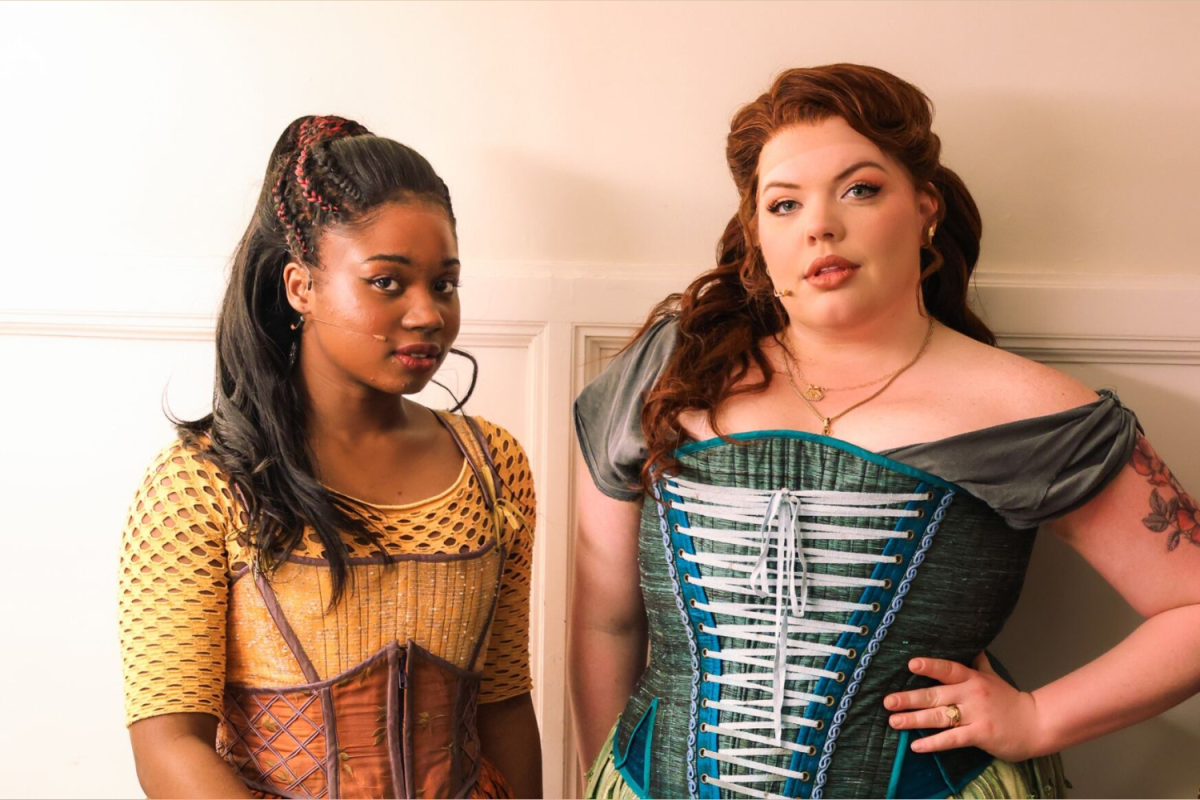
Adding to its uniqueness is the show’s striking aesthetic. Bonnets embraces a punk-rock style, complete with music, choreography, and a rebellious visual identity. The production blends historical costuming with modern punk influences, creating a look that is both grounded in the past and defiantly contemporary.
The set design mirrors this vision. Rather than recreating traditional historical environments, the stage becomes a gritty, industrial space—one that feels as though it has been reclaimed and transformed. “It’s like a place where girls came in and made it their own,” the director said. With bold lighting choices and dramatic visual elements—including, as promised in the script, an over-the-top, almost cinematic use of stage blood—the production leans fully into its theatricality.
“It actually calls for a Tarantino-level amount of blood,” the director noted, referencing American film director Quentin Tarantino. “It’s horrific, but also strangely beautiful. That contrast really captures the metaphor of the play.”
Despite its darker themes, “Bonnets” is not without humor. The show incorporates moments of comedy, music, and even dance, creating a dynamic and engaging experience for audiences. The energy of the production is heightened by its all-female cast, with female-identifying actors portraying every role—including male characters.
Beyond the performances themselves, the production is also a showcase of student collaboration. Choreography, fight direction, and music direction are all led by students, contributing to what Copeland describes as an “incredibly collaborative” and energized rehearsal process. “Everyone is working so hard, and we’re having a great time,” they said. “You can really feel that energy in the room.”
Ultimately, “Bonnets” is about more than its dramatic moments or stylistic flair. It speaks to a universal experience: the struggle to reconcile who we are with who we are expected to be. One monologue in the play, the director noted, focuses on the tension between a person’s imagined self and their true identity—a theme that resonates far beyond the stage.
For students, especially, the message may hit close to home. “Anyone who’s ever been told they couldn’t do something will relate to this,” the director said.
While the production promises shocking moments and unexpected twists, the director is keeping those details under wraps. “You’ll have to come see it,” Copeland teased.
With its fusion of history, punk energy, and powerful storytelling, Bonnets invites audiences to question expectations, embrace authenticity, and witness what happens when those expectations are pushed too far.
Bonnets: How Ladies of Good Breeding Are Induced to Murder will be opening April 22nd at 7:30pm in the Blackbox Theatre in the Kleist Center for Art & Drama. It will close with a 2pm matinee on the 26th.
