

















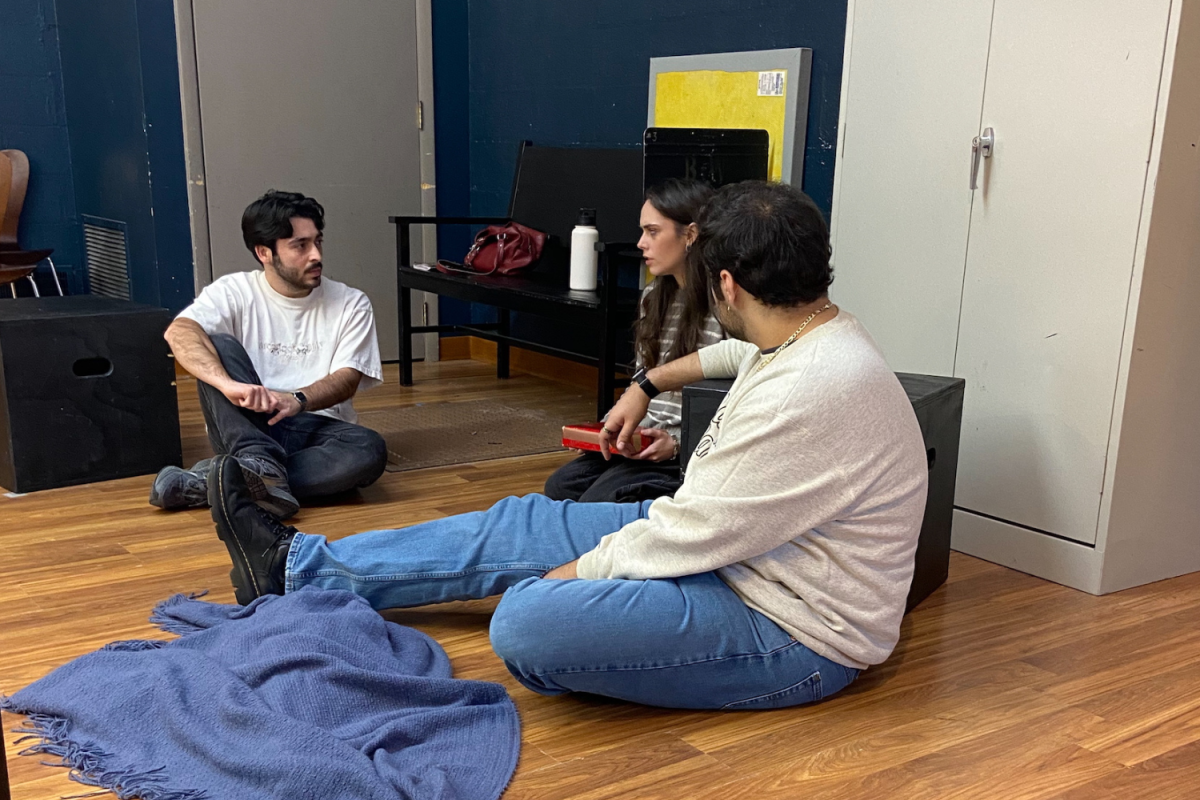
In a small intimate space with barely two feet separating actors from audience members, a play called Boy Gets Girl written by Rebecca Gilman is performed as the first Lab series of the academic year and also the last of the year of 2025. Director Abby Guinigundo, a senior stage manager major, has merged the production with careful research and inventive staging to create a version of the play that feels both immersive and alarmingly current.
Set in the late 1990s, Boy Gets Girl follows Theresa Bedell, a writer whose life shifts irreversibly after a seemingly average blind date with a man named Tony Ross. “The show starts so normal. It’s a normal first date,” the director explains. “And then it kind of goes south from there, like her life gets turned upside down from this date she went on.”
Tony Ross, played by Massimo Papa, first appears as a perfectly ordinary man. The mismatch between his harmless exterior and his escalating behavior forms the tension that drives the show. As his fixation intensifies, Theresa—played by Mikayla Adamission—finds herself trapped inside a nightmare she never saw coming.
A huge element to this story is that the set pieces should never distract from the emotional core of the story; if anything, they should add to it. With minimal furniture—primarily acting blocks—the production leans into realism. “This show is like a simulation of real life,” Guinigundo says. “I didn’t want transitions or props to take away from that.”
Guinigundo has done extensive research that extends far beyond the rehearsal room. The director has studied the play since her freshman year and even became strongly aware of cyberstalking and the legal history surrounding it. Her research reveals that anti-stalking laws in states like California and Ohio were first introduced only in the 1990s—the same period in which the play is set—and have not been meaningfully updated in more than a decade. “When I did the research two years ago, some of those laws hadn’t changed since 2010,” she says. “Technology, meanwhile, has evolved so fast that these laws can’t keep up. They don’t protect people the way they need to.”
The gap between reality and protection forms one of the show’s key themes: the system often can’t intervene until a stalker has already escalated to dangerous proximity, leaving victims effectively unprotected.
But the plays speak of something broader, too. For many women, feeling unsafe is not limited to extreme circumstances—it’s woven into daily life. “Yes, this is a story about stalking,” Guinigundo explains, “but it also shines a light on the smaller things women are expected to put up with. Things get brushed aside because they’re not as dramatic as a stalking case, even though they shape our lives.”
As the opening night approached and tickets sold out quickly, she hopes audiences come prepared for a story that is not only gripping but unsettling in its relatability. “I think the ending will shock people,” she says. “It shocked me the first time I read it. This play isn’t about the 90s—it’s about the world we’re still living in.”
Boy Gets Girl had its running in the Loomis Acting Studio from Nov. 19-22.