











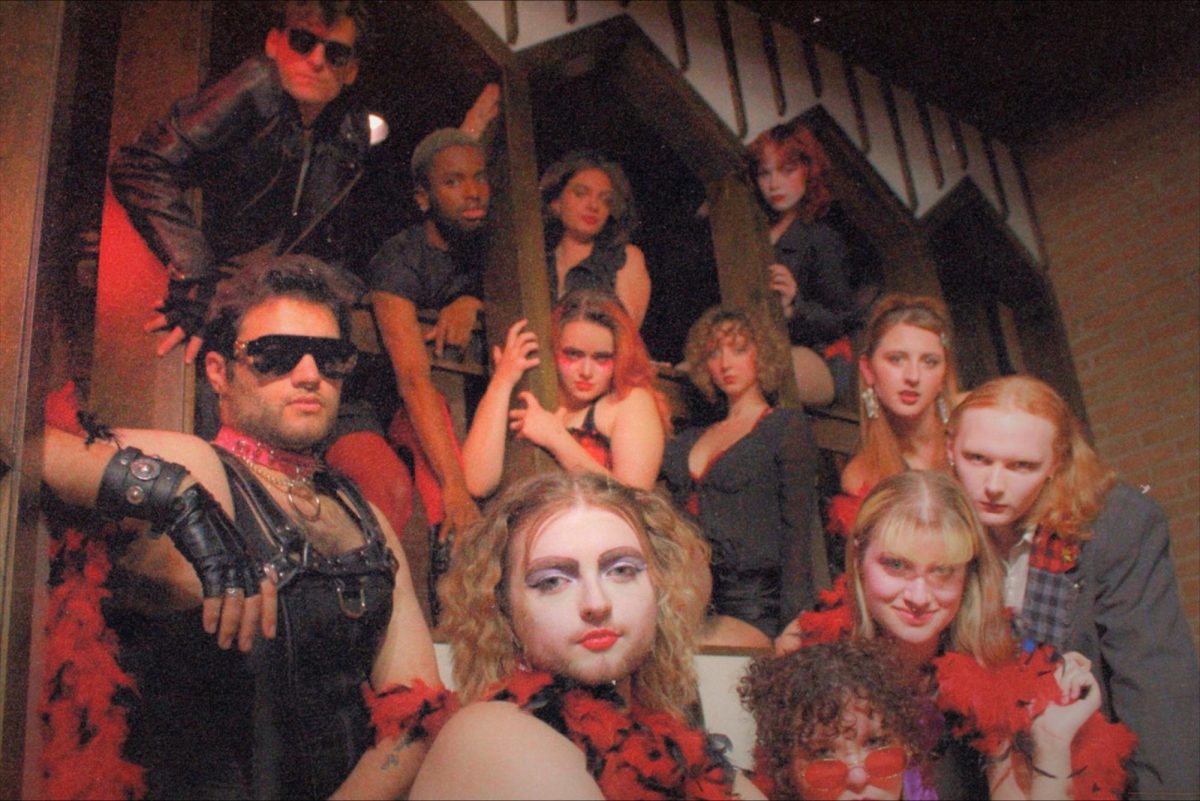
The past couple weekends, the Baldwin Wallace University community celebrated the 50th anniversary of the film “The Rocky Horror Picture Show.”
This year’s shadow cast paid a strong tribute to honor this significant part of musical history. Director David Keller and producer Mugs Johnson led a reimagining of the cult classic that honors its queer roots while embracing how far the community—and the world—has come.
This year all of the BW students involved raised the stakes even higher by intensifying a more established theme and redesigned their image. “Our theme this year is queer culture,” Johnson said, “and trying to go back to the roots of queer culture and things like ballroom, things like voguing, like really just the OG birth of the queer scene and how can we translate that onto the ‘Rocky Horror’ stage because queer culture and ‘Rocky’ are intertwined.”
Keller said that “Rocky” can be celebrated for what it used to be even though it has a completely different meaning now.
“We’re paying homage to the original source material while also making it known that the culture has evolved and that we are still very much here and there is still so much work to do, acknowledging that both of those truths exist,” Keller said.
For many, “The Rocky Horror Picture Show” is more than just a movie—it’s a movement. First released in 1975, it became a safe haven for those who felt outcast by mainstream society.
“’Rocky’ made so many people who felt like they didn’t belong realize that there was a place for them,” Keller added. “And we want this production to continue being that space of unapologetic self-expression.”
Being that there was vulnerability of appearance within the production, creating that sense of security started its work behind the scenes. The production implemented the use of an intimacy coordinator, junior BFA Connor Defevers, ensuring that every performer felt comfortable in their roles. “Safety should be a bare minimum,” said Johnson. “We strive for empowerment on top of them and giving them a space where they feel they can express themselves as they want to.”
When it comes to the show’s iconic characters, especially Dr. Frank-N-Furter, the creative team approached casting with deep care. With the well-known Tim Curry being the original portrayal, both the director and the producer were eager to explain what they ideally searched for to keep some of his originality alive. “Tim Curry’s performance in this film is something that simply can and will never be recreated,” said the director. “The actors that we cast in that role have to have that spark. They have to have that charisma.” Overall, Frank-N-Furter embodies the fluidity of gender and freedom of identity.
Even after half a century, “Rocky Horror” remains relevant. Keller stated, “‘Rocky’ is such a wonderful opportunity for them to completely shed everything that society has told them that they could or could not be, and just be exactly who they want to be, and be in a room of people who are doing the exact same thing.”
The whole spirit of this show was centered around the feeling of liberation. “‘Rocky’ is a good time,” Johnson reflected. “It does not matter if you are queer. It does not matter your race. It does not matter if you are able-bodied. There’s no qualifier for enjoying ‘Rocky’. You just have to like having a good time.”
“The Rocky Horror Picture Show” continued to be what it always was, a boundary-breaking celebration of authenticity. And if this year’s production proved anything, it’s that the legacy of “Rocky Horror” isn’t just alive—it’s thriving.
“The Rocky Horror Picture Show” opened at the BW Student Activity Center on Nov 1. at 7:30 p.m. and midnight and concluded Nov. 8 at midnight.